• Skip to main content
  • Skip to footer
  • Facebook
  • Google Business
  • Email

Insurance For Over 65

Serving Georgia, Alabama, and Florida

  • Home
  • About
    • Monthly Newsletter
  • Blog
  • Testimonials
  • Our FAQ Section
    • Medicare FAQ
    • What You Should Know About Medicare and HSA’s
    • 2026 Medicare Costs
    • How Do You Change Medicare Plans?
    • Life Insurance FAQs
  • Contact

Greg Nicholaides

April 19, 2019 By Greg Nicholaides

Telemedicine and Medicare

Forthcoming policies from CMS will open up the home as a covered site of care in which hospitals can earn payment. 

Dec. 14, 2018 – By Susan Morse,Senior Editor, Healthcare Finance

This past October, the Centers for Medicare and Medicaid Services came out with an eagerly-anticipated new rule expanding the ways providers can use telehealth and get paid by Medicare Advantage plans. 

The biggest way the rule changes the status quo, once it goes into effect in 2020, is that providers will be able to keep track of a patient’s health through remote monitoring and consumers will be able to connect to their physicians through telehealth from their homes.

IMPROVING CARE FOR CHRONIC CONDITIONS

Remote monitoring is especially important in controlling chronic conditions, diseases which affect seniors in particular.  Previously, consumers had to be in a provider’s office or another designated place, or live in a rural area, to use telehealth, at least from the standpoint of reimbursement.

Days after the new MA rule was announced, traditional Medicare also got a boost to allow for more codes for telehealth in the home, for a broader range of conditions.  Remote patient monitoring is expected to be the biggest use.

This will cut down on the amount of visits by high users of the ER and improve the management of patients’ conditions, said Dr. David McSwain, CMIO at Medical Univ. of SC.

“There’s a huge amount of investment from insurance companies,” said McSwain, who chairs the American Telemedicine Association Pediatric Telemedicine Guidelines Committee. 

The rule makes it more likely that MA plans will offer the benefits and that more enrollees will be able to use the benefits, CMS said.  What’s more, private commercial insurers and state Medicaid agencies tend to follow Medicare’s lead, McSwain said. 

CMS promoted Medicare Advantage plans ahead of open enrollment this year, and adding flexibility to telehealth only added to their attraction for insurers and consumers.  Insurers, as shown most recently by their third quarter earnings, are doing well with Medicare Advantage plans. Next year, enrollment in Medicare Advantage is projected to increase by 11.5 percent, and the number of plans to increase by 600. About a third of all Medicare beneficiaries are in a Medicare Advantage plan as compared to fee-for-serviceMedicare, and that number is projected to grow.

Adding telehealth to MA benefits increases plans’ ability to take cost out of the healthcare system.  If telehealth can do so without sacrificing quality, that’s the basis of value-based care. 

HOW PROVIDERS ARE ALREADY USING TELEHEALTH

Because of the convenience there is the potential for over-utilization, and there’s the risk of fragmented care according to McSwain.  But telehealth can have dramatic impacts on healthcare outcomes and healthcare costs, he said. 

Telehealth is driving value, CMS Administrator Seema Verma said on November 15, addressing the Alliance for Connected Care. 

Telehealth includes remote monitoring, such as for glucose and vital signs, tracking weight and blood pressure.  It spans a wide array of communication, from video visits to text messaging and phone calls. 

Medicare-age patients often have numerous doctors’ appointments. Consumers welcome the ability to connect from their homes rather than travelling to the office.  Patients with restricted mobility will often miss appointments. 

The Cleveland Clinicuses remote patient monitoring that sends live-time data back to clinicians, Verma said during the Alliance for Connected Care conference.  A mission control center at the hospital assimilates the data and if needed, triggers an intervention. 

About five years ago, Dallas Children’s Health wanted to look at telemedicine as a strategy for population health, said Julie Hall-Barrow, former vice president of Virtual Health and now the senior vice president of Network Development and Innovation. 

Telehealth is being used in the children’s hospital for remote patient monitoring programs, such as digital sensors that measure medication compliance.  “We set the stage knowing it’s covered,” Hall-Barrow said of reimbursement. “I think anytime we reduce barriers for how to deliver care, it’s a win for everybody,” she said. It offers, “the ability for us to provide high quality care at any delivery point.” 

The big picture for telehealth is how to design programs in a way that lead to improved outcomes that have the biggest impact on cost of care access and quality, McSwain said. 

The Medical University of South Carolina is one of only two national Telehealth Centers of Excellence in the United States. The system is currently awaiting word on a National Institutes of Healthgrant that would allow it to leverage a network of healthcare institutions across the country to facilitate the design and completion of telehealth studies, such as what is being taught at MUSC. 

Bryan Adams, chief commercial officer at digital health company GreatCall, said of telehealth, “Everyone is interested. Everyone is trying to find out the right entry point.”  GreatCall provides cell phones, medical alert devices and sensors for independent living at home. Sensors can monitor for risk, such as for falls from a bed or chair, or even be put in the tank of a toilet to detect toilet flushes.  The use of the sensor has resulted in the reduction in the use of long-term care and acute hospitalization, Adams said. 

“This is truly a whole new world of healthcare innovation,” Verma said of telehealth. 

McSwain added that CMS’s new flexibilities “sent a serious wave of excitement around the country.  We’ve been fighting the battle for telehealth in the home, it’s been such a barrier. Those restrictions coming down is like the fall of the Berlin Wall.

___________

‘Greg Says’believes that telehealth and telemedicine have a big role to play in reducing the overall cost of healthcare in the USA.  Now that there are additional financial incentives for healthcare providers to adopt these tools to remotely serve patients, the door is opening to increased use.


Filed Under: Medicare

April 19, 2019 By Greg Nicholaides

Should You Take Social Security at 62?

If you can wait a few years or longer, you can boost your benefits – and your spouse’s.

Key takeaways

  • If you claim Social Security at age 62, rather than waiting until your full retirement age (FRA), you can expect up to a 30% reduction in monthly benefits.
  • For every year you delay past your FRA up to age 70, you get an 8% increase in your benefit. So, if you can afford it, waiting could be the better option.
  • Health status, longevity, and retirement lifestyle are 3 variables that can play a role in your decision on when to claim your Social Security benefits.

When it comes to Social Security, it can be tempting to take the money and run as soon as you’re eligible—typically at age 62. After all, you’ve likely been paying into the system for all of your working life, and you’re ready to receive your benefits. Plus, guaranteed monthly income is nice to have.

Health status, longevity, and retirement lifestyle are 3 key factors that can play a role in your decision on when to claim your Social Security benefits. You may not be able to predict the true impact of these variables, but you can rely on the simple fact that if you claim early versus later, you will likely have lower benefits from Social Security to help fund your retirement over the next 20–30+ years.

If you start taking Social Security at age 62, rather than waiting until your full retirement age (FRA), you can expect up to a 30% reduction in monthly benefits with lesser reductions as you approach FRA. Remember, FRA is no longer age 65. It now ranges from 66 to 67, depending on your date of birth. And your annual cost-of-living adjustment (COLA) is based on your benefit. So if you begin Social Security at 62, and start with reduced benefits, your COLA-adjusted benefit will be lower too.

Waiting to claim your Social Security benefit will result in a higher benefit. For every year you delay past your FRA, you get an 8% increase in your benefit. That could be at least a 24% higher monthly benefit if you delay claiming until age 70. But, make sure to evaluate your decision based on how much you’ve saved for retirement, your other sources of income in retirement, and your expectations for longevity.

While many people could benefit from waiting to age 70 to take Social Security payments, others may need this source of guaranteed income sooner to help pay their bills, or may anticipate that they may not live long enough to reap the rewards of delaying.

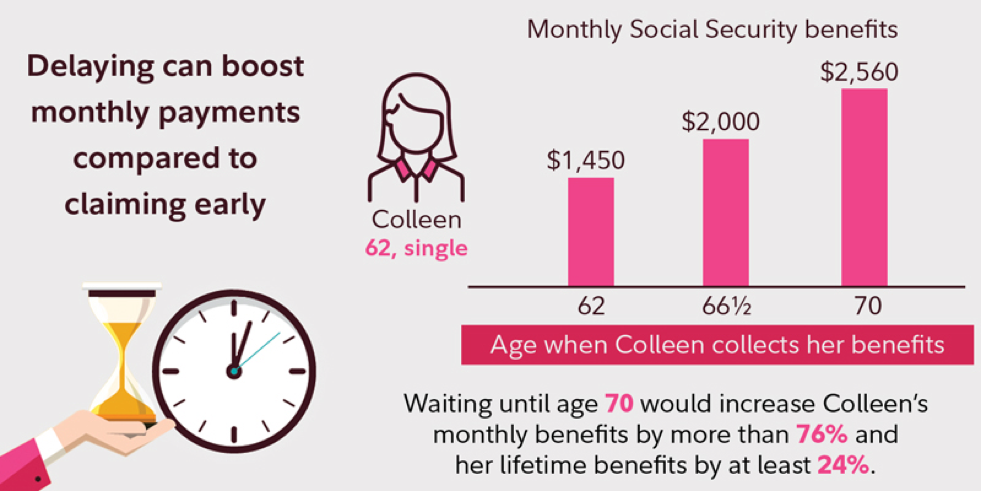
For illustrative purposes only. Note: All lifetime benefits are expressed in today’s dollars, and life expectancy of 89. The numbers are sensitive to, and would change with, the discount rate (the rate used when discounting the future benefit payments for each claiming age) and life expectancy assumptions.

The downside of claiming early: Reduced benefits

Consider the following hypothetical example. Colleen is 62 as of 2019. If Colleen waits until age 66 and 6 months (her FRA) to collect, she will receive approximately $2,000 a month. However, if she begins taking benefits at age 62, she’ll only receive $1,450 a month. This “early retirement” penalty is permanent and results in her receiving up to 28% less year after year.

However, if Colleen waits until age 70, her monthly benefits will increase another 28% over what she would receive at her FRA, to a total of $2,560 per month. If she were to live to age 89, her lifetime benefits would be about $114,000 more, or at least 24% greater, because she had waited until age 70 to collect Social Security benefits. (Note: All figures are in today’s dollars and before tax; the actual benefit would be adjusted for inflation and would possibly be subject to income tax.)

Spouses and Social Security

Several Social Security claiming strategies were eliminated in 2015 including the ability to file a “restricted application for spousal benefits,” which allowed you to claim benefits based on your spouse’s work record and then switch to claiming on your own work record at a later date. This strategy is no longer possible if you turned age 62 after December 31, 2015.

Claiming before your FRA on a spouse’s record means you’ll lose even more than claiming on your own record—the benefit reduction for a spouse is up to 35% while the reduction for claiming your own benefit is up to 30%. For instance, if you’re the spouse of Colleen in the above example and you are the same age, you’d be eligible for only $675 a month at age 62, 33% less than the $1000 a month you would get at your FRA of 66 and 6 months.

Your decision to take benefits early could outlive you. If you were to die before your spouse, they would be eligible to receive your monthly amount as a survivor benefit—if it’s higher than their own amount. But if you take your benefits early, say at age 62 versus waiting until age 70, your spouse’s survivor Social Security benefit could be up to 30% less for the remainder of their lifetime.

Bridge to Medicare

Remember that while you are eligible for reduced Social Security benefits at 62, you won’t be eligible for Medicare until age 65, so you will probably have to pay for private health insurance in the meantime. That can eat up a large chunk of your Social Security payments. For the average 55- to 64-year-old, total health care spending was $10,137 in 2016 (including $1,310 in out-of-pocket spending ). Taking Social Security early to pay for temporary health care cost locks in a permanent Social Security reduction.

Benefits of working longer

Many people want to retire as soon as it is financially feasible to do so, but it’s crucial to consider the earning and investing power you may give up if you stop working full-time and take Social Security at 62. If you leave a job with good pay and benefits, it may be difficult ever to regain that level of compensation if you need or want to return to work later. Of course, not everyone can keep working, but it is something to consider if you are healthy and have the opportunity to stay in the workforce, in either a full-time or part-time capacity.

Tip:Women often live longer than men, and are more likely to depend on one income when they are older. Don’t make the mistake of coupling your decision to leave the workforce with your Social Security claiming strategy. Remember, by the time you get into your 80s, you have fewer financial options, so don’t jump at the first opportunity to claim Social Security at age 62 just because you may want to quit your current job.

But there’s even more to the story. As you approach retirement, you’re often at the upper-end of your lifetime earnings trajectory—and of your ability to save more for retirement. In addition, if you can keep working, you can make “catch-up” contributions to a tax-deferred workplace savings plan like a 401(k) or 403(b) or a traditional or Roth IRA. Catch-up contributions allow you to set aside larger amounts of money for retirement.

Remember, if you decide to stop working at 62, you will cease tax-advantaged saving opportunities and cap your Social Security benefits throughout your retirement—and you may need to begin to draw down your savings earlier than you want.

When you factor in longevity, health care, and the cost of your expected lifestyle in retirement, your decision on whether or not to claim Social Security at age 62 may become clearer.

Greg Saysbelieves it’s wise to consult with a financial planner before deciding to take your Social Security Retirement Benefit before your full retirement age.

Filed Under: Uncategorized

March 6, 2019 By Greg Nicholaides

What is the New “Right to Try” Law?

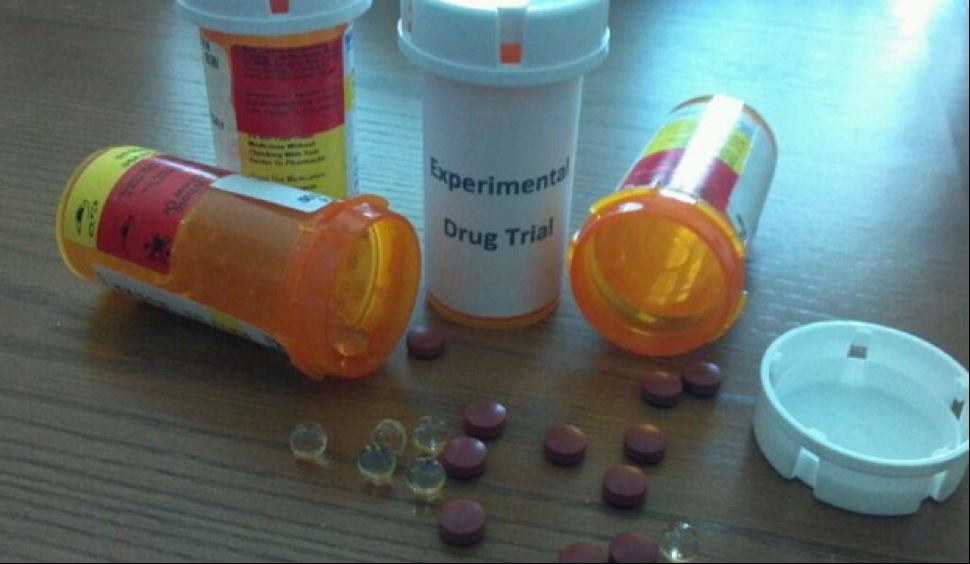
In June 2018 President Trump signed into law the “Right to Try” bill.  This bill basically allows terminally ill patients access to experimental medical treatments and drugs that aren’t yet approved by the Food and Drug Administration (FDA).  Surprisingly, even though two politically vulnerable Democrat Senators, Joe Donnelly and Joe Manchinco sponsored the bill, most Democrats and public health groups opposed it, arguing that it could put patients in danger, with Democrat Frank Pallone referring to it as a product of “snake oil salesmen.”  The “Right to Try” isn’t limited to Medicare patients but is available to all ages.

Already, 40 states have passed their own right to try laws, and it seems like a fairly simple idea, but it’s not. Previously, an FDA rule required that a terminally ill patient could try an experimental drug if it had passed the first of three clinical trials. The first clinical trial reviews whether or not a new drug is safe, but not if it’s effective. But, the new bill gives terminally ill patients a chance to improve their condition if they have exhausted all FDA-approved treatments. Also, a provision of the bill doesn’t require a patient to apply to the FDA for approval. And…the new law doesn’t require the drug company to provide the experimental product, so this may be a two-edged sword. Drug companies are concerned over the legality involved if a person dies from taking a drug, which could imperil FDA approval at a later date.

Filed Under: Uncategorized

March 6, 2019 By Greg Nicholaides

How to Get the Most From a Health Savings Account

By Ann Carns – The New York Times

Dec. 7, 2018

Choosing a health savings account can be daunting, especially for people funding one for the first time. But some comparison shopping can help minimize fees and maximize savings, researchers say.

Providers of health savings accounts are generally doing a better job of disclosing details like fees and investment options, said Leo Acheson, associate director of multi-asset and alternative strategies at the financial research firm Morningstar. But, he added, “there’s still some room for improvement.”

While updating an analysis of 10 big providers of the accounts, he said, Morningstar found that just four made all details — like fees charged — available on their websites.

A health savings account, or H.S.A. — available when paired with a specific type of high-deductible health insurance plan — offers triple tax benefits. You can contribute to an H.S.A. through paycheck deductions, reducing your taxable income; interest or investment gains are tax free; and withdrawals aren’t taxed, either, as long as you spend the money on eligible items or treatment. If you don’t have health coverage through your employer, you can make tax-deductible contributions on your own to an H.S.A., as long you have a compatible health plan.

Money in the accounts can be used for current health and medical expenses, or invested for care in the future. According to Fidelity Investments, a couple who are 65 years old and retiring in 2018 may need about $280,000 to cover health costs in retirement, and funding an H.S.A. can help with that burden.

But most H.S.A. holders don’t appear to be saving for the long term, according to findingsfrom the Employee Benefit Research Institute, which analyzed a database of about six million accounts. Most account holders, the institute reported in October, appear to be using H.S.A.s as “specialized checking accounts,” not investment accounts.

People generally use the money to cover current costs, like deductibles and co-payments, rather than contributing as much as possible and investing for the future. Over all, two-thirds of account holders withdrew funds — an average of $1,725 — in 2017. Just 5 percent of account holders had investments other than cash.

That may be because most people simply can’t afford to pay for health care out of pocket and need the cash in the accounts for medical bills, said Paul Fronstin, director of the institute’s health research and education program. Or, he said, it could be that people still think of H.S.A.s as flexible health spending accounts, a different sort of workplace account with fewer perks. Unlike those accounts, H.S.A.s are portable, so you can take yours with you if you change jobs.

Over time, however, H.S.A. holders appear to become more comfortable with investing. In 2017, for instance, 10 percent of accounts that had been opened a decade earlier had investments other than cash, compared with just 2 percent of those opened in 2017, the institute found.

 “It takes time to learn how these things work,” Mr. Fronstin said.

Whether you are using your H.S.A. for saving or for investing, it’s wise to compare fees and other features offered by different accounts, Mr. Acheson said.

If you have health insurance through your employer, your H.S.A. account is usually chosen for you, and your employer probably pays any monthly maintenance fee. But if you’re buying insurance on your own — or if you don’t like the investment options available in the account your employer offers — you can choose another account provider. Mr. Acheson suggests keeping your company’s H.S.A. to receive any employer contributions, then transferring the money periodically to the second H.S.A.

Morningstar recently rated 10 large account providers available to individuals, based on whether the account is mainly for spending, or for investing.

Spenders should look for H.S.A.s that offer checking accounts with no monthly maintenance fees, reasonable interest on deposits and Federal Deposit Insurance Corporation insurance, Mr. Acheson said.

Investors should also look for low fees, whether on “passive” index fund investments or actively managed funds, and no threshold on investments or a low one. (Some accounts require a minimum balance — often $1,000 to $2,000 — to be maintained in the checking account before money can be invested.)

Morningstar ranked the H.S.A. Authority, offering accounts through Old National Bank in Indiana, as the best for both spenders and investors.

Fifth Third Bank’s H.S.A. is “compelling” for spenders, the report found, if they are able to keep an average of at least $4,000 in their checking account. The bank paid a somewhat higher interest rate on deposits, and if that $4,000 balance was maintained, the bank waived its monthly fee.

Accounts from Further, an account administrator formerly known as SelectAccount, and Bank of America were deemed “solid” choices for investors.

The analysis didn’t include H.S.A.s from Fidelity because the company didn’t begin offering the accounts to individuals outside employer plans until Nov. 15, after the report was completed.

Eric Remjeske, president of the H.S.A. research firm Devenir, said that it made sense to evaluate the costs of a plan, but that consumers should also consider what they were getting for the extra fees. Some higher-fee accounts, for instance, may offer more services, like the availability of “robo” advisers to help with investment selections.

Devenir offers HSAsearch.com, a tool that includes more than 500 accounts, to help consumers compare H.S.A.s.

Here are some questions and answers about health savings accounts:

How much can I contribute to an H.S.A. for 2019?

An individual can contribute up to $3,500 for 2019, while the limit for family coverage is $7,000.  People 55 and older can contribute an extra $1,000. Contributions for 2018 can be made up until the tax filing deadline in April.

How do I know if my health plan is compatible with an H.S.A.?

Most plans that qualify to have a health savings account will be labeled “H.S.A. eligible.” If you’re not sure, ask the insurance company or your employer. For 2019, criteria include a deductible of at least $1,350 for an individual and $2,700 for a family.

What can I buy with my H.S.A.?

You can spend the money on a wide variety of “qualified” expenses, including doctor visits, eyeglasses, fertility treatment and drug addiction treatment. For a complete list, see I.R.S. Publication 502. Be sure to keep receipts, or benefit statements from your insurer, in case you have to document your spending, Mr. Fronstin said. If you spend the money on non-eligible items, the withdrawal is taxed as income, plus a 20 percent penalty. After you turn 65, the penalty goes away, and you’ll pay just income taxes on nonqualified withdrawals.

Filed Under: Uncategorized

March 6, 2019 By Greg Nicholaides

New Cigna Study Reveals Loneliness at Epidemic Levels in America

By Ellie Polack, Cigna

01 May 2018

Research Puts Spotlight on the Impact of Loneliness in the U.S. and Potential Root Causes 

Global health service company Cigna (NYSE: CI) has released results from a national survey exploring the impact of loneliness in the United States. The survey, conducted in partnership with market research firm, Ipsos, revealed that most American adults are considered lonely.  And loneliness is particularly acute among Americans over age 50 among whom one in eleven lacks a spouse, partner, or living child.  That’s approximately 8 million people in the US without close kin – one of the main sources of companionship in old age. 

The evaluation of loneliness was measured by a score of 43 or higher on the UCLA Loneliness Scale, a 20-item questionnaire developed to assess subjective feelings of loneliness, as well as social isolation. The UCLA Loneliness Scale is a frequently referenced and acknowledged academic measure used to gauge loneliness. 

The survey of more than 20,000 U.S. adults ages 18 years and older revealed some alarming findings: 

  • Nearly half of Americans report sometimes or always feeling alone (46 percent) or left out (47 percent). 
  • One in four Americans (27 percent) rarely or never feel as though there are people who really understand them. 
  • Two in five Americans sometimes or always feel that their relationships are not meaningful (43 percent) and that they are isolated from others (43 percent). 
  • One in five people report they rarely or never feel close to people (20 percent) or feel like there are people they can talk to (18 percent). 
  • Americans who live with others are less likely to be lonely (average loneliness score of 43.5) compared to those who live alone (46.4). However, this does not apply to single parents/guardians (average loneliness score of 48.2) – even though they live with children, they are more likely to be lonely. 
  • Only around half of Americans (53 percent) have meaningful in-person social interactions, such as having an extended conversation with a friend or spending quality time with family, on a daily basis. 
  • Generation Z (adults ages 18-22) is the loneliest generation and claims to be in worse health than older generations. 
  • Social media use alone is not a predictor of loneliness; respondents defined as very heavy users of social media have a loneliness score (43.5) that is not markedly different from the score of those who never use social media (41.7). 

“We view a person’s physical, mental and social health as being entirely connected,” said David M. Cordani, president and chief executive officer of Cigna. “It’s for this reason that we regularly examine the physical, mental and social needs of our people and the communities they live in. In analyzing this closely, we’re seeing a lack of human connection, which ultimately leads to a lack of vitality – or a disconnect between mind and body. We must change this trend by reframing the conversation to be about ‘mental wellness’ and ‘vitality’ to speak to our mental-physical connection. When the mind and body are treated as one, we see powerful results.” 

The survey also revealed several important bright spots. The findings reinforce the social nature of humans and the importance of having communities. People who are less lonely are more likely to have regular, meaningful, in-person interactions; are in good overall physical and mental health; have achieved balance in daily activities; and are employed and have good relationships with their coworkers. More specifically, the survey showed: 

  • People who engage in frequent meaningful in-person interactions have much lower loneliness scores and report better health than those who rarely interact with others face-to-face. 
  • Getting the right balance of sleep, work, socializing with friends, family and “me time” is connected to lower loneliness scores. However, balance is critical, as those who get too little or too much of these activities have higher loneliness scores. 
    • Sleep: Those who say they sleep just the right amount have lower loneliness scores, falling four points behind those who sleep less than desired and 7.3 points behind those who sleep more than desired. They are significantly less likely to feel as though they lack companionship (37 percent vs. 62 percent of those who oversleep) and are significantly more likely to feel like they have someone they can turn to (85 percent vs. 71 percent). 
    • Spending time with family: Those who spend more time than desired with their family and those who spend less time than desired are on par with one another when it comes to experiencing feelings of loneliness. Those who report spending too much time with family stand out as being more likely than those who don’t to say that they feel as though they are part of a group of friends (73 percent vs. 64 percent) and they can find companionship when they need it (74 percent vs. 67 percent). 
    • Physical activity: People who say they get just the right amount of exercise are considerably less likely to be lonely. The loneliness score of those who exercise more than desired increases by 3.5 points, while a similar uptick is seen for those who exercise less than desired (3.7 points). Those who exercise more than desired and those exercising for just the right amount are on par when it comes to feeling as though they are part of a group of friends (79 percent, each), have a lot in common with others (75 percent of those who exercise more vs. 79 percent who exercise just right), and can find companionship when they want it (76 percent vs. 80 percent). 
    • The workplace: Those who say they work just the right amount are least likely to be lonely – the loneliness score of those who work more than desired increases by just over three points, while those who work less than desired showed a 6-point increase in loneliness. Not surprisingly, those who report working less than desired are less likely to report having feelings associated with being less lonely (e.g., feeling outgoing and friendly, there are people you can talk to, etc.), compared to those who work more than desired. 

“There is an inherent link between loneliness and the workplace, with employers in a unique position to be a critical part of the solution,” said Douglas Nemecek, M.D., chief medical officer for Behavioral Health at Cigna. “Fortunately, these results clearly point to the benefits meaningful in-person connections can have on loneliness, including those in the workplace and the one that takes place in your doctor’s office as a part of the annual checkup. While one solution won’t stop this growing public health issue, we’ve started to make changes to our business to help our clients and others to tackle loneliness and realize their vitality.” 

Cigna is launching an effort to help address the loneliness epidemic and improve Americans’ overall mental wellness and vitality. As a first step, the company is calling on other like-minded organizations to join in the fight against the epidemic. By working together, the hope is that a group of companies and organizations can develop solutions that help improve vitality and reduce feelings of loneliness for Americans. 

Cigna has several programs already in place to help address loneliness: 

  • Cigna’s Health Advisor program connects customers with health coaches who provide real connections and live advice to help customers understand what is going on in their lives and encourage them to make healthier decisions when it comes to exercise, healthy eating, stress management and tobacco use. 
  • The company’s Health Information Line is always available, so customers can speak with a clinician directly to get advice on confidential health issues or listen to pre-recorded audio on a wide range of health topics. 
  • Last year, Cigna opened its counseling help line to all veterans and their caregivers as well. 
  • Cigna’s Employee Assistance Program (EAP) provides live telephone advice and practical solutions on a wide range of issues that can cause stress and isolation, including parenting and childcare, senior care, pet care, identity theft, legal and financial advice, and much more. Cigna’s EAP also provides referrals to licensed behavioral health professionals to improve customers’ mental wellness. 
  • Cigna’s CLIMB (Changing Lives by Integrating Mind and Body) is a program taught in groups or one-on-one that is designed to help people manage chronic health issues that affect their day-to-day functioning and improve quality of life. The program also helps reduce the isolation that often comes with chronic health conditions. 
  • In Korea, Cigna’s business has a program where employees call senior customers and their caregivers to provide a human check-in and alleviate potential feelings of loneliness or isolation. 
  • To highlight the importance of mental wellness as a part of regular medical care, Cigna is piloting a new initiative to better integrate behavioral health services into its collaborative care arrangements. The program will ensure that patients get the integrated care they need for their physical and mental wellness – as opposed to keeping physical and mental care separate. 

Additionally, loneliness has a profound impact on the workplace in terms of productivity. To help employers address this pressing issue, Cigna will convene a group of its clients to discuss steps that can be taken and potential solutions to improve vitality and address loneliness in the workplace. 

Greg Says believes loneliness is a growing problem particularly among America’s senior population.  Here are some simple, small steps seniors can take to make more meaningful connections with others.

1. Face-to-Face Time. Phone calls, emails, even Skype or FaceTime are effective, and when friends or family live far away, they can be your only options. But it’s important to have in-person interactions too. In fact, a 2015 study found that the mental health benefits of regular face-to-face social interactions — especially among older adults — reduced the risk of depression.

Things you can try:

  • Set up a regular coffee or tea date with a friend.
  • Invite someone to have lunch or dinner with you at home.
  • Take your dog for a walk in a park where there are people you can chat with.

2. Group Activities. The Australian study mentioned earlier found that for every group involvement that participants lost in the year after retirement, their quality of life went down by 10%. Even if you don’t like big groups, there are ways to be involved in right sized groups that will make life better:

  • Volunteer at a nonprofit, school or civic group. If you’re not sure where to start, check out Connect2Affectand VolunteerMatch, websites that will help you find volunteer opportunities in your area.
  • Explore options at your local church or synagogue, such as group studies, choirs or service projects.
  • Have some fun with a regular bridge or poker night, book club or sewing group.

3. Senior Living Communities. Many residents of senior living communities say that having so many ways to meet people has made their lives incredibly rich. Between events, activities, clubs, dining venues, and having neighbors their same age, they discover new friends that feel like family. Some couples decide to move to a community as part of planning for the future. If anything should happen to one of them, the other will have support to feel less lonely.

Loneliness shouldn’t be brushed aside as a normal part of aging. Acknowledge it, then take the first step toward a better — and possibly longer — life.

Filed Under: Uncategorized

  • « Go to Previous Page
  • Page 1
  • Interim pages omitted …
  • Page 40
  • Page 41
  • Page 42
  • Page 43
  • Page 44
  • Interim pages omitted …
  • Page 46
  • Go to Next Page »
  • Facebook
  • Google Business
  • Email

Copyright © 2026 | Insurance For Over 65